


A new hire lands in Dubai ready to start, but their Emirates ID application has no clear owner, payroll hasn’t been configured, and nobody’s tracking whether the labour contract even got registered with MOHRE yet. This isn’t a rare scenario, it’s what happens when onboarding gets treated as a welcome email instead of a regulated process.
In the UAE, onboarding isn’t just about laptops and orientation decks. It’s a sequence of government filings, deadlines, and legal obligations that starts the moment an offer letter is signed, not on the employee’s first day. Miss a step or get the order wrong, and you’re looking at real penalties, not just an awkward first week. Here’s the complete checklist, broken down by phase, with the specific rules behind each step.
Why UAE Onboarding Starts Before Day One
Most onboarding advice online focuses on culture and welcome kits. In the UAE, that’s the easy part. The harder, non-negotiable part starts as soon as a candidate accepts an offer, because several government processes need to be initiated before the employee’s actual start date.
Under Federal Decree-Law No. 33 of 2021, employers must secure MOHRE work permit approval and register the employment contract before the employee begins work. Treating onboarding as something that starts on day one means you’re already behind schedule, since visa processing, medical testing, and Emirates ID issuance all take real time to move through government systems.
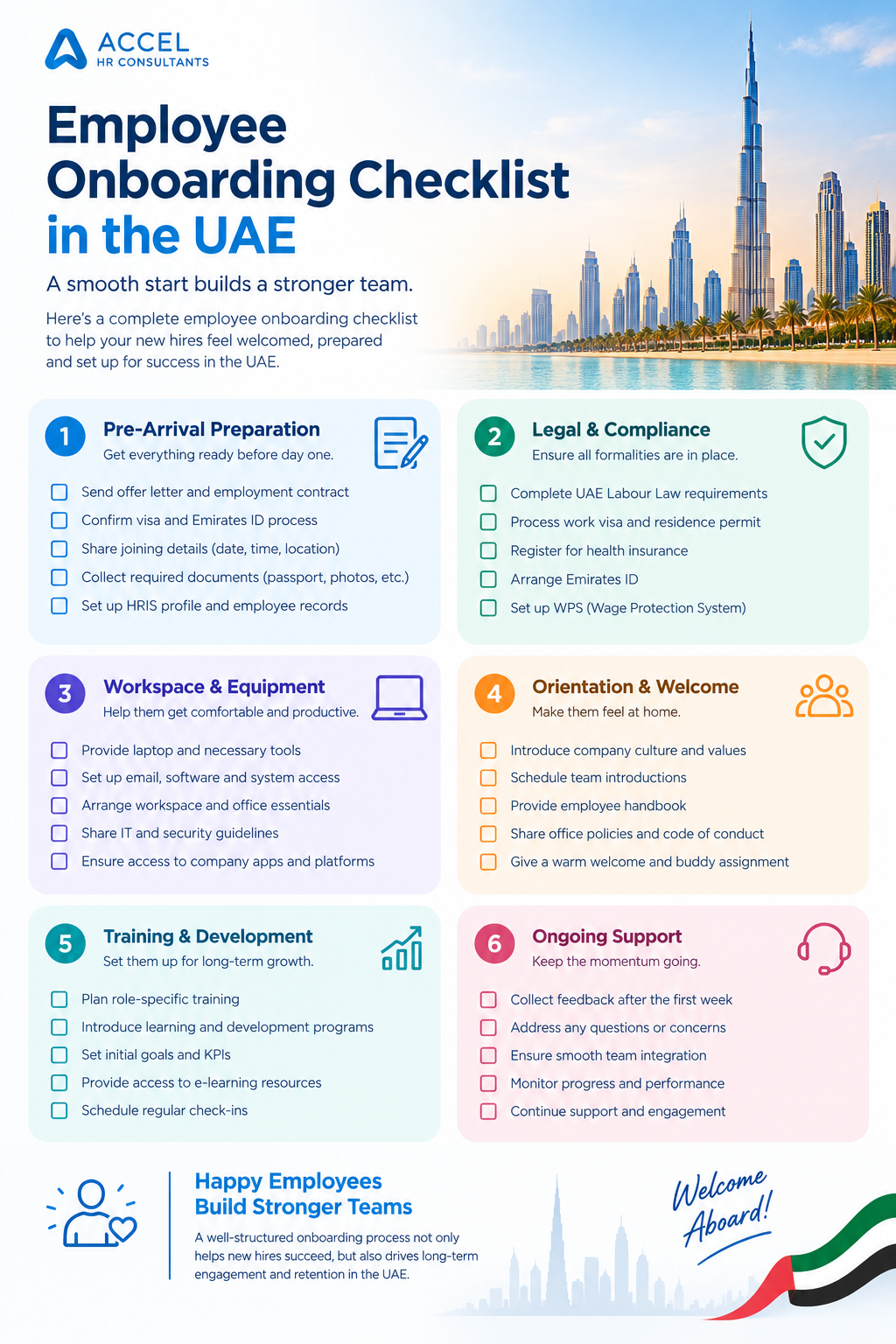
The Onboarding Checklist, Phase by Phase
Pre-Arrival: Before the Start Date
This phase happens entirely on paper, but it’s the foundation everything else depends on. The employer needs to apply for the MOHRE work permit and register the signed employment contract, since this has to be in place before the employee legally starts working. For candidates coming from outside the UAE, this also means initiating the entry permit and beginning the residence visa application process.
If a medical fitness test will be required, scheduling it in advance here saves time once the employee arrives, rather than treating it as a same-day task.
Day One: Arrival and Initial Registration
Once the employee is in the country, the clock starts on a few time-sensitive steps. A medical fitness examination, typically a chest X-ray and blood test, confirms the employee meets UAE health screening requirements. This needs to happen promptly, since it’s a prerequisite for the residence visa moving forward.
If the employment contract wasn’t finalized during pre-arrival, it gets signed here. This is also when practical setup begins, IT system access, a bank account for salary purposes, and an introduction to the immediate team.
First Week: Registration and Payroll Setup
With the medical clearance in hand, the employee applies for their Emirates ID, including biometric verification, once the residence visa is approved. The Emirates ID isn’t optional paperwork, it’s required for banking, healthcare access, and virtually every government service the employee will need going forward.
This is also when mandatory health insurance registration needs to be completed, and when the employee needs to be added to payroll ahead of the Wage Protection System cycle. Missing the WPS enrollment window for a new hire creates a compliance flag before their first paycheck even goes out.
First Month: Probation and Integration
Beyond the paperwork, the first month is where structured orientation and early performance expectations get set. This includes a proper introduction to company policies, clear first-priorities discussions with the employee’s manager, and the start of formal probation tracking.
A well-run orientation program here does more than paperwork ever could for retention, since employees who understand their role and feel genuinely welcomed in the first month are far more likely to stay past their first year.
Additional Steps When Onboarding an Emirati Employee
This is where most onboarding checklists fall short, they’re written entirely around expatriate hiring and skip the requirements specific to UAE national employees. If you’re onboarding an Emirati hire, three additional obligations apply on top of the standard process.
As of January 1, 2026, MOHRE set the minimum monthly wage for Emiratis in the private sector at AED 6,000, confirmed on the official UAE Government portal. This applies to all new, renewed, and amended work permits, and this salary must be paid through WPS like any other employee.
The employer also has to register the Emirati employee with the General Pension and Social Security Authority (GPSSA) within one month of the work permit being issued, with a combined contribution equal to 20% of salary split between employer and employee. Separately, if the role qualifies for Nafis support, registration on the Nafis platform needs to happen at the point of hire. Nafis benefits aren’t backdated if this registration gets delayed, so this isn’t a step that can wait until later.
How Long Does Onboarding Actually Take?
| Employee Type | Typical Timeline | Main Factors |
|---|---|---|
| Expatriate, hiring from abroad | 2 to 4 weeks | Visa processing, medical test, Emirates ID issuance |
| Expatriate, already in the UAE | 1 to 2 weeks | Faster, since residence status already exists |
| UAE national | 1 to 2 weeks | Primarily contract signing and government registration |
These are typical ranges, not guarantees. Government processing times fluctuate, and any missing documentation on the employee’s side can extend the timeline considerably.
What Happens If a Step Gets Skipped or Reordered?
Sequencing matters as much as completing each step individually. Skipping MOHRE contract registration, delaying visa processing, or reversing the required order of operations counts as a labour law violation, one employees can report directly to MOHRE.
The financial consequences are significant. Standard violations carry fines ranging from AED 5,000 to AED 100,000 per instance, while serious or repeated violations under Federal Decree-Law No. 9 of 2024 can reach as high as AED 1,000,000 per employee. Beyond fines, MOHRE can suspend a company’s ability to issue new work permits, which stalls hiring entirely until the issue is resolved.
Disclaimer: This article summarizes the general onboarding framework under UAE federal labour law and MOHRE procedure. Specific requirements can vary by free zone or emirate, so it’s worth confirming current requirements for your exact situation, especially for Emirati hires given how frequently minimum wage and Emiratisation rules have shifted through 2026.
Free Zones Follow a Different Process
Not every onboarding sequence in the UAE runs through MOHRE. Financial free zones like DIFC and ADGM operate under their own independent employment and immigration frameworks, separate from the federal system described above. Other free zones, like JAFZA and DMCC, generally follow MOHRE-aligned processes but route visa sponsorship through their own free zone authority rather than MOHRE directly.
If your company operates across both mainland and free zone entities, it’s worth confirming which onboarding pathway applies before assuming one checklist covers every hire.
Building an Onboarding Checklist Your HR Team Can Actually Follow
A checklist only works if it’s actually followed consistently, and that’s harder than it sounds once a company scales past a handful of hires a year. The businesses that get this right treat onboarding as a tracked workflow with clear ownership at each stage, not a document someone glances at occasionally.
If your current process relies on someone remembering which steps apply to which type of hire, expat versus Emirati, mainland versus free zone, that’s exactly where things get missed. A properly documented employee handbook paired with clear onboarding ownership removes most of that risk before it turns into a MOHRE compliance issue.
FAQs
Q1: When does UAE onboarding actually start?
It starts when the offer letter is signed, not on the employee’s first physical day. MOHRE work permit approval and contract registration need to happen before the start date, which means the process is already underway before onboarding “feels” like it’s begun.
Q2: How long does UAE onboarding typically take?
For expatriate hires coming from abroad, 2 to 4 weeks is typical, mainly due to visa processing, medical testing, and Emirates ID issuance. UAE nationals and expatriates already residing in the UAE usually complete onboarding faster, within 1 to 2 weeks.
Q3: Are there different onboarding requirements for Emirati employees?
Yes. On top of standard onboarding, employers must pay a minimum monthly wage of AED 6,000 (effective January 2026), register the employee with GPSSA within one month of work permit issuance, and complete Nafis registration at the point of hire if applicable.
Q4: What happens if a company misses an onboarding compliance step?
Penalties range from AED 5,000 to AED 100,000 for standard violations, and up to AED 1,000,000 per employee for serious or repeated violations under Federal Decree-Law No. 9 of 2024. MOHRE can also suspend a company’s work permit privileges until the issue is resolved.
Q5: Do free zone companies follow the same onboarding checklist as mainland companies?
Not exactly. DIFC and ADGM operate under entirely separate employment frameworks. Other free zones generally follow MOHRE-aligned processes but route visa sponsorship through their own free zone authority.
A Final Thought
Onboarding in the UAE rewards employers who treat it as a compliance sequence with real deadlines, not a checklist to improvise on the fly. Getting the order right, work permit before start date, medical test before Emirates ID, WPS registration before the first pay cycle, protects both the company and the new hire from unnecessary risk.
If you’re setting up an onboarding process from scratch, or your current one has too many manual handoffs to track reliably, Accel HR’s team can help you build a system that actually holds up as your company scales.