


A new employee assumes sick leave and annual leave work the same way everywhere, until they actually get sick and discover their pay drops partway through recovery. Someone else expects maternity leave to cover the full six months they’ve heard about from friends back home, only to find the UAE’s structure is different. Confusion about leave entitlements is one of the most common sources of workplace disputes in the country, and most of it comes down to simply not knowing which leave type applies, and how each one actually pays out.
UAE Labour Law defines a specific set of leave categories, each with its own eligibility rules, duration, and pay structure. This guide walks through every major leave type under Federal Decree-Law No. 33 of 2021, so you know exactly what you’re entitled to, and what your employer actually owes you.
Annual Leave
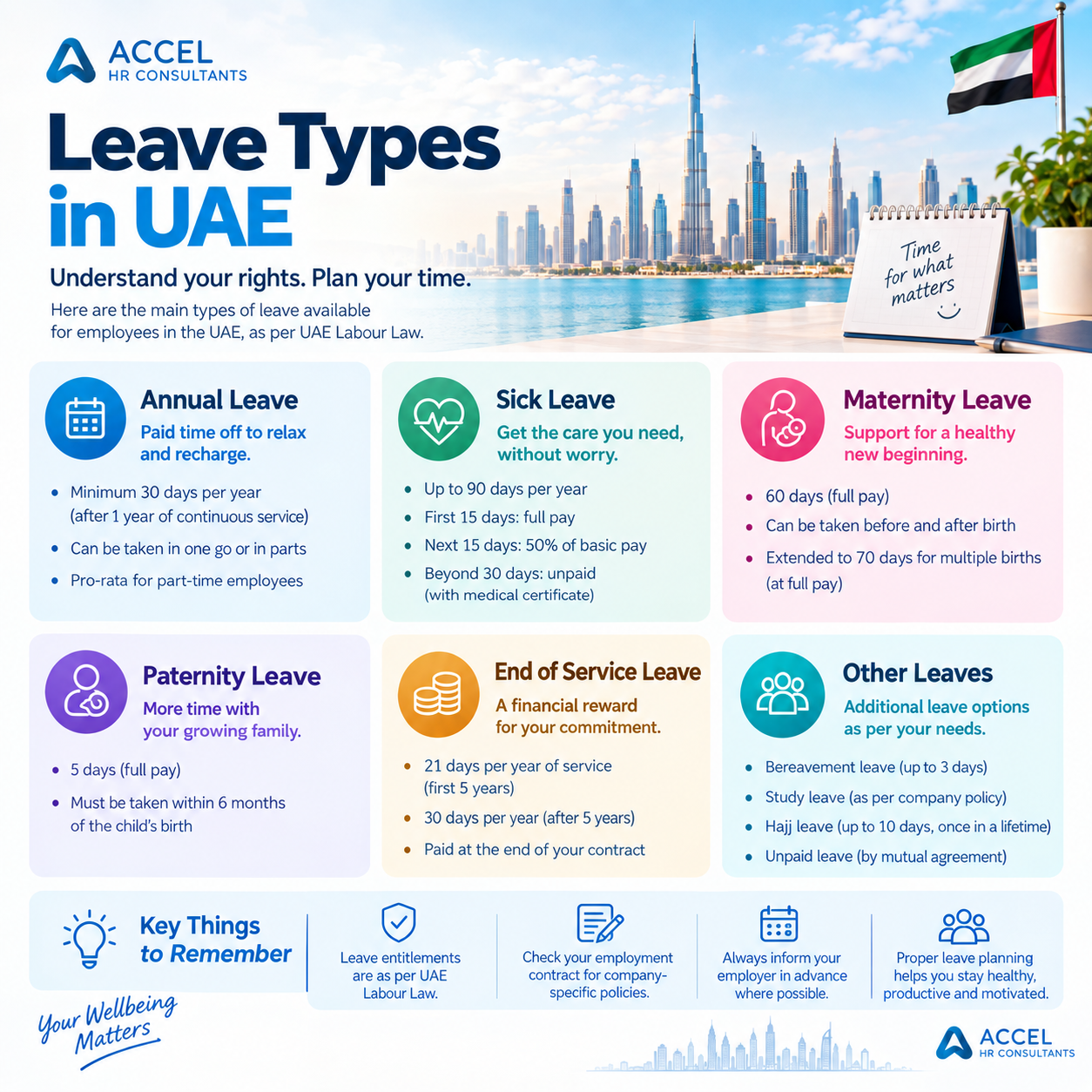
Annual leave is the most commonly used, and most disputed, leave category. Under Article 29, employees who complete one year of service are entitled to 30 calendar days of paid annual leave per year. Employees between six months and one year of service accrue leave at 2 days per month.
Annual leave is calculated in calendar days, meaning weekends falling within a leave period count toward the total. If you want the full formula for how annual leave pay and encashment actually get calculated, our detailed guide on leave salary calculation in the UAE covers the math step by step.
Sick Leave
Sick leave often surprises people because the pay structure isn’t flat. Under Article 31, employees are entitled to up to 90 days of sick leave per year, whether taken continuously or intermittently, but the payment tiers down as the duration increases.
The first 15 days are paid in full, the next 30 days at half pay, and the remaining 45 days are unpaid. Employees must notify their employer of illness within three days and submit a medical report from a licensed medical entity to qualify. Importantly, an employer cannot dismiss an employee or issue a termination notice while they’re on valid sick leave. If someone exhausts the full 90 days and still can’t return to work, the employer may terminate the contract, but the employee remains entitled to their standard end-of-service gratuity.
Quick Fact: Sick leave generally doesn’t apply during the probation period in the same way it does afterward, so newer employees should check their specific contract terms rather than assuming the full 90-day structure applies from day one.
Maternity Leave
Maternity leave under Article 30 provides 60 days total: the first 45 days at full pay, and the remaining 15 days at half pay. This applies regardless of length of service, as long as the employee is currently employed.
If a newborn is born with a medical condition or disability requiring constant care, the mother is entitled to an additional 30 days at full pay, with the option to extend by a further 30 days unpaid, supported by a medical report. In the difficult circumstance where a child is lost after six months of pregnancy, the employee still retains the full maternity leave entitlement. After returning to work, mothers are also entitled to one or two nursing breaks a day, totaling no more than one hour, for six months following their return.
Parental Leave
This is one of the more recently introduced entitlements, and it applies to both parents, not just mothers. Under Article 32, employees are entitled to 5 working days of paid parental leave, which can be taken continuously or in separate days, any time between the child’s birth and six months afterward.
For mothers, parental leave is entirely separate from, and additional to, maternity leave. Fathers are entitled to the same 5 days independently. This entitlement was introduced following 2020 amendments to the Labour Law, formally recognizing shared childcare responsibility in a way the older law didn’t address.
Bereavement (Compassionate) Leave
UAE Labour Law provides paid bereavement leave for the death of an immediate family member, with the duration depending on the relationship. Employees receive 5 days of paid leave for the death of a spouse, and 3 days for the death of a parent, child, sibling, grandparent, or grandchild. This leave entitlement begins from the date of death, and most legal guidance clarifies that in-laws generally fall outside this specific list of covered relationships.
Study Leave
Employees who’ve completed at least two years of service and are enrolled in an accredited UAE educational institution can request paid study leave, generally around 10 days a year, to sit for exams. This entitlement typically applies specifically to UAE national employees pursuing further education, so eligibility can vary depending on your specific employment situation.
Hajj Leave
Muslim employees are entitled to unpaid leave, once during their entire period of employment, to perform Hajj. This leave is generally capped around 30 days and requires at least one year of service, with the specific arrangement typically left to employer discretion and company policy.
National and Reserve Service Leave
UAE national employees called up for national or reserve military service are entitled to leave for the duration of that service, in line with the UAE’s National Service Law. This is a distinct entitlement separate from annual or unpaid leave and applies specifically to Emirati employees.
Unpaid Leave
Once an employee has exhausted their statutory paid leave entitlements, additional unpaid leave is available entirely at the employer’s discretion. There’s no automatic legal right to unpaid leave beyond what’s already covered under the categories above, so approval depends on individual company policy and the specific circumstances involved.
Comparing All Leave Types at a Glance
| Leave Type | Duration | Pay Structure | Eligibility |
|---|---|---|---|
| Annual Leave | 30 calendar days/year | Full pay | 1 year of service |
| Sick Leave | Up to 90 days/year | 15 days full, 30 days half, 45 days unpaid | Immediate, with medical report |
| Maternity Leave | 60 days | 45 days full, 15 days half | Currently employed |
| Parental Leave | 5 working days | Full pay | Within 6 months of birth |
| Bereavement Leave | 3–5 days | Full pay | Immediate family death |
| Study Leave | ~10 days/year | Full pay | 2 years of service, enrolled student |
| Hajj Leave | Up to 30 days | Unpaid | 1 year of service, once per employment |
| Unpaid Leave | Employer discretion | Unpaid | After statutory leave is exhausted |
What Happens When Leave Types Overlap or Aren’t Used
A few practical questions come up often. Sick leave, maternity leave, parental leave, and bereavement leave generally aren’t encashable, meaning if you don’t use them, they simply lapse rather than converting into a cash payout later. Annual leave works differently, unused days can be carried forward within limits or encashed, which is why it’s the leave type most closely tied to final settlement calculations. If you’re leaving a role and want to understand exactly what happens to your unused entitlements, our guide on employee termination in the UAE covers how leave, gratuity, and notice pay all come together in a final settlement.
Disclaimer: This article summarizes the general leave framework under UAE federal labour law for informational purposes. Free zones like DIFC and ADGM may apply different rules, and individual contracts can offer more generous terms, so it’s worth confirming your specific entitlements with HR or checking directly with MOHRE for your situation.
FAQs
Q1: How many days of sick leave am I entitled to in the UAE? Up to 90 days per year under Article 31, structured in tiers: the first 15 days at full pay, the next 30 at half pay, and the final 45 unpaid. A medical report is required to qualify.
Q2: Is parental leave the same as maternity leave? No. Parental leave is a separate 5-day paid entitlement available to both parents within six months of a child’s birth. For mothers, it’s in addition to the standard 60-day maternity leave, not a replacement for it.
Q3: Can unused sick or maternity leave be paid out in cash? No. Unlike annual leave, sick leave, maternity leave, parental leave, and bereavement leave aren’t encashable. If they aren’t used, they simply expire rather than converting into a payout.
Q4: Do all these leave types apply to free zone employees? Most apply consistently across mainland and standard free zones, since they fall under Federal Decree-Law No. 33 of 2021. DIFC and ADGM operate under their own separate employment frameworks, so it’s worth checking specific entitlements if you work in either zone.
Q5: How much bereavement leave am I entitled to? It depends on the relationship. UAE Labour Law provides 5 days of paid leave for the death of a spouse, and 3 days for the death of a parent, child, sibling, grandparent, or grandchild, starting from the date of death.
A Final Thought
UAE leave entitlements cover far more ground than most employees realize, annual and sick leave get most of the attention, but parental, bereavement, and study leave often go unused simply because people don’t know they exist. Knowing exactly what applies to your situation means you’re not caught off guard the one time you actually need to use it.
If you’re an employer trying to make sure your leave policies are documented correctly and applied consistently, or an employee unsure what you’re owed in a specific situation, Accel HR’s team can help you get clarity on exactly where you stand.