


A company grows from 15 employees to 55, and somewhere in that growth, nobody updated the HR policies. The handbook still doesn’t mention Emiratisation quotas, the grievance process only exists informally through the office WhatsApp group, and there’s no documented anti-harassment procedure at all. Then a dispute happens, and there’s nothing written down to fall back on.
This is a more common story than most business owners realize. UAE HR policies aren’t a single document you write once and forget, they’re a set of specific, legally grounded requirements that scale with your headcount and evolve as the law changes. Here’s what’s actually required, and where most companies fall behind.
Why HR Policies Matter More Than a Generic Handbook
A lot of businesses treat their employee handbook as a formality, a document handed out during onboarding that nobody reads again. In the UAE, that approach creates real exposure. Federal Decree-Law No. 33 of 2021, combined with Emiratisation regulations and WPS requirements, means several specific policies aren’t optional extras, they’re compliance obligations that MOHRE can and does inspect.
Getting this right isn’t just about avoiding fines either. Clear, properly documented policies are what protect a company when a dispute actually happens, since MOHRE and UAE labour courts look at whether policies existed and were communicated, not just whether the outcome felt fair in hindsight.
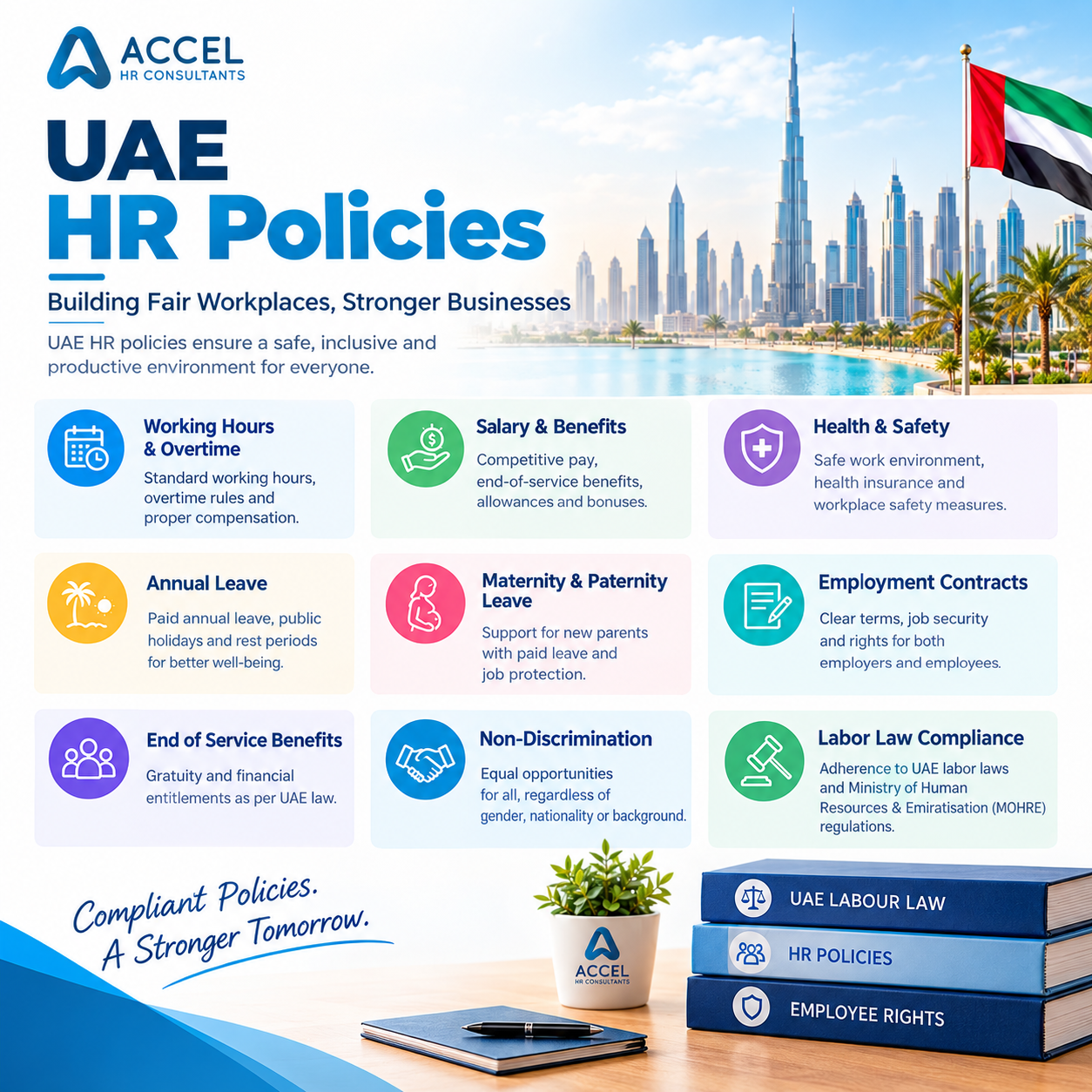
Employment Contract and Probation Policies
Every employment relationship in the UAE starts with a fixed-term contract, since unlimited contracts were abolished in February 2022. Your HR policies need to reflect this accurately, including probation terms that match what’s actually registered with MOHRE.
Under Article 9, probation cannot exceed 6 months, either party can terminate with 14 days’ written notice during this period, and probation cannot be applied twice for the same employee in the same role. A handbook that states a different probation duration than what’s on the MOHRE-registered contract creates a direct compliance mismatch, and it’s one of the more common gaps found during audits. Our dedicated guide on the probation period in the UAE covers these rules in more depth, including what happens if an employee wants to switch employers mid-probation.
Anti-Harassment and Equal Opportunity Policies
This is one of the areas where the law has gotten notably more specific in recent years. Current labour law explicitly addresses workplace discrimination, harassment, and equality, and this can’t be left vague in company documentation anymore. A compliant policy needs to document the employer’s equal opportunity commitment, clearly define what constitutes harassment, establish an actual reporting process, and explicitly protect employees from retaliation after raising a complaint.
For companies with 50 or more employees, this becomes even more important, since written grievance and disciplinary policies are a specific compliance requirement at that size, not just good practice. If your company is approaching this threshold, it’s worth reviewing this policy area before, not after, you cross it.
Emiratisation Policies
Emiratisation compliance has become one of the most consequential parts of UAE HR policy, and the targets tighten every year. Companies with 50 or more employees are required to increase Emirati hires in skilled roles, with the overall goal reaching a 10% Emiratisation rate, as outlined on the official UAE Government Emiratisation portal. Companies in the 20 to 49 employee range have their own specific hiring requirements that scale by year.
The penalties for non-compliance are substantial and increase annually. For 2026, non-compliant companies face a monthly contribution of AED 9,000 per unfilled Emirati position, a figure that rises by AED 1,000 each year going forward. Beyond the direct fines, non-compliant companies risk work permit restrictions that can stall hiring entirely. HR policies should build in structured Emiratisation planning rather than treating quota compliance as a last-minute scramble each year, since career pathways for Emirati employees need genuine development, not just a headcount number to hit. The Nafis platform is where employers register and report this data quarterly, and it also offers salary and pension support that can help offset the cost of hiring Emirati talent.
Quick Fact: As of January 1, 2026, the minimum monthly wage for Emirati employees in the private sector is AED 6,000, with a compliance deadline of June 30, 2026 for existing staff. From July 1, 2026, non-compliant companies face work permit suspensions, and affected employees stop counting toward Emiratisation targets entirely.
Leave, Working Hours, and Compensation Policies
Your HR policies need to clearly document leave entitlements, working hours, overtime rules, and how flexible arrangements like part-time, remote, and hybrid work actually operate within your company. This matters more since these flexible work models are now formally recognized under UAE employment law, which means a handbook that doesn’t address them is genuinely out of date, not just incomplete.
If you’re building out this section, our detailed guides on leave types in the UAE and working hours in the UAE cover the specific legal requirements each policy needs to reflect accurately.
Payroll and WPS Compliance Policies
Every private-sector employer must pay salaries electronically through WPS-approved institutions, monitored jointly by MOHRE and the UAE Central Bank. This isn’t really an “HR policy” in the traditional sense, it’s closer to a payroll operations requirement, but it needs to be documented and understood by HR staff regardless, since WPS non-compliance creates a compounding risk. Late or missing WPS submissions don’t just trigger direct MOHRE penalties, they can also block Nafis registration for Emirati hires, which simultaneously creates Emiratisation compliance exposure on top of the original payroll issue.
For the full mechanics of how this system works, our guide on the Wage Protection System in the UAE breaks down exactly what employers need to have in place.
Workplace Health and Safety Policies
All UAE employers are required to provide a safe working environment that complies with UAE occupational health and safety standards. This requirement applies regardless of industry, though what it looks like in practice varies significantly between an office environment and a construction site. HR policies should reflect the actual working conditions specific to the business rather than relying on a generic template that doesn’t match real operational risks.
How Often Should HR Policies Be Reviewed?
Treating your handbook as a one-time document is one of the most common mistakes UAE companies make. Policies should be reviewed whenever your headcount crosses a compliance threshold, particularly the 20 and 50 employee marks that activate new Emiratisation and grievance policy requirements. They should also be revisited immediately after any MOHRE complaint or internal dispute, since a gap exposed during an actual claim needs closing right away, not at the next scheduled review.
Beyond those trigger points, an annual compliance review is worth building into your HR calendar as standard practice, given how frequently UAE labour regulations have shifted through 2026 alone.
Disclaimer: This article summarizes the general HR policy framework under current UAE labour law for informational purposes. Specific obligations can vary by free zone, company size, and sector, so it’s worth confirming your exact requirements with an HR consultant or checking directly with MOHRE for your situation.
Building Policies That Actually Hold Up
Writing policies that look complete on paper is one thing. Building ones that actually get followed, and that hold up when MOHRE reviews them or a dispute lands in labour court, is a different challenge entirely. This is where a properly structured employee handbook, paired with clear HR policies and procedures built around your company’s actual size and structure, makes the real difference.
FAQs
Q1: What HR policies are legally required in the UAE?
At minimum, companies need policies covering employment contracts and probation, anti-harassment and equal opportunity, leave and working hours, and Emiratisation compliance if headcount thresholds apply. Companies with 50+ employees also need documented grievance and disciplinary procedures.
Q2: At what company size do Emiratisation policies become mandatory?
Companies with 50 or more employees face specific annual Emiratisation targets toward a 10% goal. Companies with 20 to 49 employees have their own scaled requirements, so it’s worth reviewing your obligations as headcount grows.
Q3: How often should a UAE employee handbook be updated?
At minimum annually, and immediately whenever your company crosses a compliance threshold like 20 or 50 employees, or after any MOHRE complaint or internal dispute exposes a gap in existing policy.
Q4: Do HR policy requirements differ for free zone companies?
Some do. Most free zones follow MOHRE-aligned requirements, but DIFC and ADGM operate under entirely separate employment frameworks, so policies need to reflect whichever regulatory system actually applies to your entity.
A Final Thought
HR policies in the UAE aren’t really about having a thick handbook, they’re about having the right documents in place before you need them, aligned with your actual company size and how the law currently reads, not how it read two years ago. Getting this right protects both the business and the people working there.
If your current policies haven’t been reviewed in a while, or you’re scaling past a compliance threshold and aren’t sure what changes, Accel HR’s team can help you build a policy framework that actually holds up.