


A company lands its biggest client yet, plans to hire five new employees to deliver, and discovers mid-process that its visa quota is exhausted. What should have been a two-week sponsorship turns into a six-week scramble involving quota increase requests and delayed start dates.
Visa sponsorship in the UAE isn’t a single form filled out once. It’s a recurring compliance responsibility that touches your trade licence, your MOHRE quota, your payroll setup, and your ongoing legal standing with the government, and it doesn’t end once the employee is settled, since many go on to sponsor their own families afterward. Here’s exactly how the process works in 2026, what it costs, what documents you’ll actually need, and where sponsorship most commonly goes wrong.
Who Can Actually Sponsor Someone in the UAE?
Sponsorship in the UAE isn’t limited to employers. The law recognizes several categories of legal sponsor: licensed UAE companies and free zone entities sponsoring their employees, UAE nationals sponsoring family members and domestic workers, resident expatriates sponsoring immediate family once they meet a minimum salary threshold, and investors who qualify for self-sponsorship. This guide focuses primarily on employer sponsorship, since that’s the pathway most companies and job seekers actually navigate, but the family sponsorship route matters too, since it’s usually the very next question a new hire asks once their own visa is sorted.
For a company to sponsor foreign workers at all, it needs a valid, active trade licence, an up-to-date establishment card, and no outstanding fines or compliance restrictions with MOHRE. A lapsed establishment card alone freezes every pending visa transaction until it’s renewed. Beyond basic eligibility, the company needs available quota, the number of foreign employees it’s licensed to sponsor, tied directly to trade licence type and office space. Hiring before quota approval is confirmed exposes both the company to fines and the employee to genuine legal risk.
Mainland vs Free Zone Sponsorship
Where your company is licensed determines which authority processes the sponsorship, and the two paths aren’t interchangeable.
| Mainland | Free Zone | |
|---|---|---|
| Sponsoring authority | MOHRE | Respective free zone authority (JAFZA, DMCC, DIFC, ADGM, etc.) |
| Standard visa validity | 2 years | 2 to 3 years, depending on the zone |
| Where employee can legally work | Anywhere in the UAE | Within the free zone, unless additional approval is obtained |
| Contract framework | Full federal Labour Law | Zone-specific contract, though most mirror federal law closely |
A free zone employment visa cannot legally authorize work on the UAE mainland without securing separate approval first, a detail that catches companies off guard when a free zone employee starts taking on mainland client work.
The Sponsorship Process, Step by Step
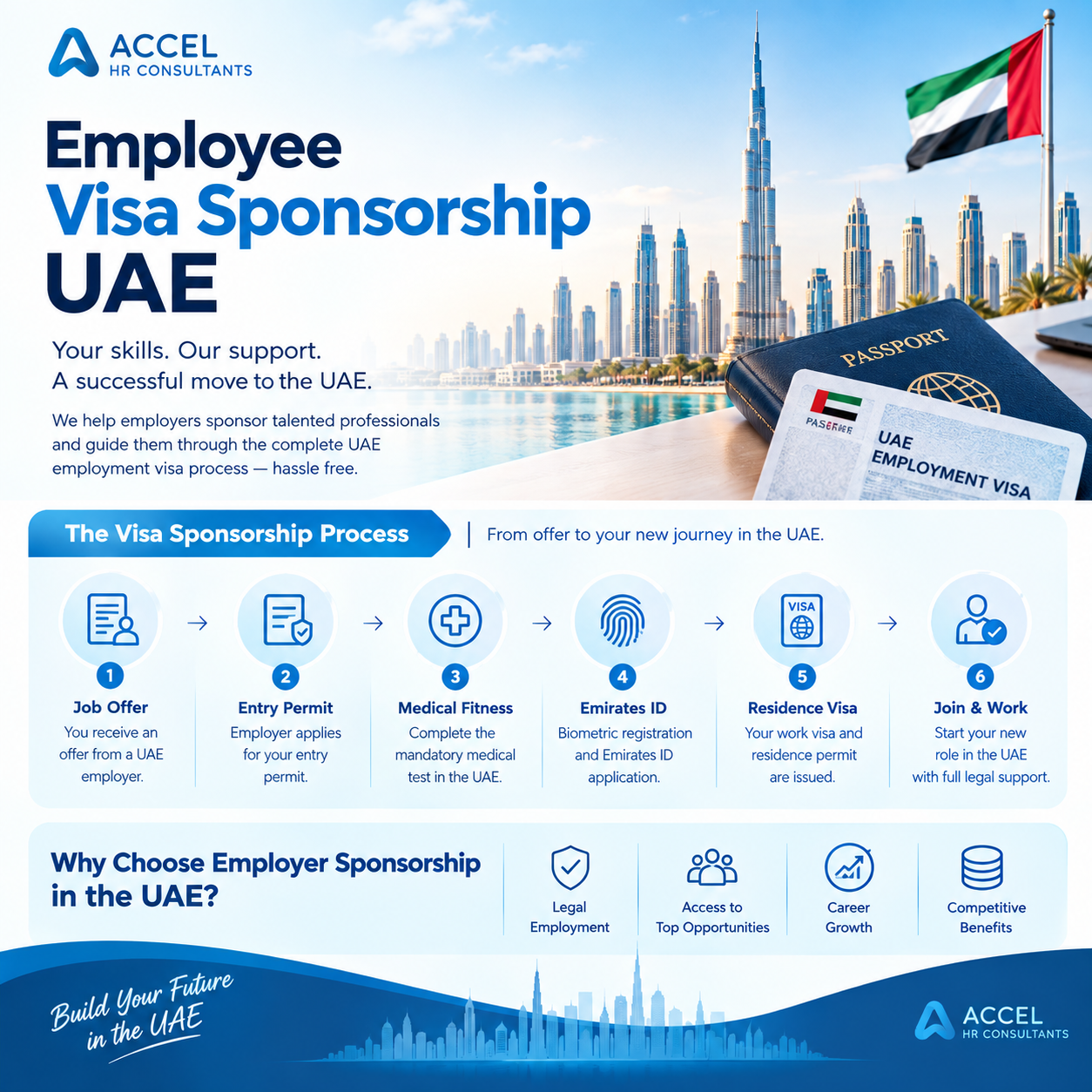
Quota and eligibility confirmation. The employer confirms sponsorship eligibility and secures quota approval, through MOHRE’s Tas’heel system for mainland companies or the relevant free zone portal for free zone entities.
Offer letter and contract. A formal offer letter is issued and signed, then uploaded to MOHRE with the quota request. As of May 2026, MOHRE’s “Work Bundle” initiative has streamlined this into a five-step, five-document process with a five-working-day target, reviewed by MOHRE’s AI system, internally called “Eye,” which checks name consistency, attestation, and qualification fit before human review.
Entry permit. If the employee is outside the UAE, an entry permit is issued, valid for 60 days, allowing entry to complete the remaining steps.
Medical fitness test. Within 14 days of arrival, the employee completes a government-approved medical exam, screening for infectious diseases including HIV, hepatitis B, and tuberculosis.
Emirates ID and residence visa. Once cleared, the employee applies for their Emirates ID with biometrics, and the employment contract, signed in Arabic and English, gets registered with MOHRE. The residence visa is stamped by ICP or GDRFA in Dubai, formally activating sponsorship.
Payroll and insurance. The final step registers the employee for WPS payroll and arranges mandatory health insurance, both required before the first full pay cycle.
Documents You’ll Actually Need
For employer sponsorship, the core document set includes the company’s valid trade licence, the signed labour contract, the sponsor’s Emirates ID, the employee’s passport copy (valid at least six months), a recent passport-size photo, and the medical fitness certificate once completed. Missing or mismatched documentation, particularly a job title on the contract that doesn’t match what’s licensed under the trade activity, is one of the most common reasons applications stall.
If the employee plans to bring family over afterward, it’s worth knowing the family sponsorship document set looks different: the sponsor’s passport and Emirates ID, an attested marriage certificate for a spouse, attested and translated birth certificates for children, a registered tenancy contract (Ejari) as proof of accommodation, and salary certificates or payslips covering the last three months.
Family Sponsorship: The Question That Comes Right After
Once an employee’s own visa is active, sponsoring a spouse, children, or parents becomes possible, but it isn’t automatic, and it isn’t free. Resident expatriates need to earn at least AED 4,000 per month to sponsor family, or AED 3,000 per month if their employer provides accommodation as part of the package, the so-called “AED 3,000 rule” that exists specifically to accommodate mid-level roles in sectors like hospitality and retail where housing is commonly included.
There’s no separate salary threshold for a spouse versus children, the same minimum applies, though immigration officers can request recent bank statements to confirm financial capacity for each additional dependent. Siblings fall outside standard family sponsorship entirely and generally require a different visa route altogether, like a long-term visit visa.
Sponsor-Free Pathways Worth Knowing About
Not every foreign national in the UAE needs a traditional employer or family sponsor. The Golden Visa offers 10-year self-sponsored residency for investors, entrepreneurs, and exceptional talent, no employer required. The Green Visa provides 5-year residency for skilled workers and freelancers meeting specific criteria, useful for contractors who don’t sit under a single employer’s sponsorship. A Remote Work Visa exists for people employed abroad who simply want to live in the UAE, and student and retirement visas cover their own distinct categories. If a candidate you’re hiring already holds one of these, the standard employer sponsorship process described above may not apply to them at all.
How Long Does Sponsorship Actually Take?
For a new hire coming from abroad, the full end-to-end process typically runs 2 to 6 weeks, depending on documentation readiness and whether you’re going through mainland or free zone. Government-side processing under the 2026 Work Bundle targets five working days, but that covers only the permit approval stage, not the entry permit, medical testing, and Emirates ID steps around it.
| Visa Type | Standard Processing |
|---|---|
| Employment/Employer visa | 3–7 working days |
| Family residence visa | 5–10 working days |
| Golden Visa | 10–30 working days |
If you’re checking status partway through, both work visas and labour cards can now be verified directly through MOHRE’s online status check tools.
What Sponsorship Actually Costs
Costs vary by company classification. MOHRE sorts private-sector establishments into tiers based on compliance history and Emiratisation participation, and this directly determines work permit fees, ranging roughly from AED 250 to AED 3,450 per permit for employer sponsorship. Separately, family residence visas typically run somewhere in the range of AED 3,000 to AED 5,500 for a spouse and AED 1,500 to AED 3,000 per child, plus medical fitness testing at roughly AED 250 to AED 350 per person.
Quick Fact: Deducting visa or sponsorship costs from an employee’s salary is explicitly prohibited under Federal Decree-Law No. 33 of 2021, and any amount improperly deducted is legally recoverable by the employee. For employer sponsorship specifically, this cost sits with the company, full stop, it’s never something that can be quietly passed on to the person being sponsored. Our detailed guide on salary deductions in the UAE covers exactly what an employer can and cannot legally deduct.
Where Sponsorship Most Commonly Goes Wrong
A handful of mistakes account for most compliance issues companies run into. Missed renewal deadlines are the most frequent, since a lapsed visa, permit, or insurance policy triggers fines, often accumulating daily, and can force an urgent exit-and-re-entry process to correct. Mismatched job titles cause trouble too, since the MOHRE-registered title needs to match both the trade licence activity and any dependent visa applications, and mismatches tend to surface during audits when they’re hardest to fix quietly. Hiring beyond an approved quota exposes both employer and employee to legal risk the moment it happens, not just once it’s discovered.
Disclaimer: This article summarizes the general sponsorship framework under UAE federal regulations for informational purposes. Requirements and fees vary by emirate, free zone, and company classification, so it’s worth confirming current requirements with MOHRE or a licensed PRO before submitting an application.
What Happens When Employment Ends
Sponsorship doesn’t end quietly when someone resigns or is terminated. The employer formally cancels the work permit and visa, triggering a grace period, typically around 30 days, during which the former employee can secure new sponsorship or exit the country legally. If an employee is switching jobs rather than leaving the UAE, there’s no need to leave the country at all, the new employer processes an in-country status change, and as long as the notice period was properly served, there’s no labour ban standing in the way.
FAQs
Q1: Can an employer deduct visa sponsorship costs from an employee’s salary? No. This is explicitly prohibited under Federal Decree-Law No. 33 of 2021. Any amount deducted for this purpose is legally recoverable by the employee.
Q2: What’s the minimum salary needed to sponsor family in the UAE? AED 4,000 per month without employer-provided accommodation, or AED 3,000 per month if housing is included in the employment package. This applies equally whether sponsoring a spouse or children.
Q3: How long does the full visa sponsorship process take for a new hire from abroad? Typically 2 to 6 weeks from offer letter to a fully stamped residence visa, depending on documentation readiness and whether the hire is going through mainland or free zone processing.
Q4: What’s the difference between mainland and free zone sponsorship? Mainland sponsorship runs through MOHRE and allows work anywhere in the UAE. Free zone sponsorship runs through the specific free zone authority and generally restricts work to within that zone unless additional approval is secured.
Q5: Can someone get a UAE visa without any sponsor at all? Yes. The Golden Visa (10-year self-sponsored residency for investors and exceptional talent) and Green Visa (5-year residency for skilled workers and freelancers) are both sponsor-free pathways, alongside remote work, student, and retirement visa categories.
A Final Thought
Visa sponsorship in the UAE rewards employers who treat it as an ongoing system, tracked deadlines, correct classifications, quota planned in advance, rather than a one-time task handled per hire. Get the sequence right, and a new employee is legally working within weeks, with a clear path to bringing their family over once they’re settled.
If your company is scaling hiring and your sponsorship process is starting to feel harder to track manually, Accel HR’s team can help you manage the process properly, from quota planning through to a fully compliant, sponsored hire.