


Your salary lands short again, this time labeled “adjustment,” last month it was “damages,” the month before that, nobody explained it at all. Salary deductions are one of the most common flashpoints between UAE employers and employees, and the frustrating part is that most of these deductions shouldn’t be happening the way they are, or shouldn’t be as large as they are.
UAE Labour Law is actually quite specific here. There’s a closed list of five reasons an employer can deduct from your pay, an individual cap on each one, a hard aggregate ceiling, and an explicit list of costs that can never be passed on to you. Here’s exactly what the law allows, down to the exact percentages, and what to do if a deduction on your payslip doesn’t add up.
Basic Salary vs. Total Salary: Why This Distinction Decides Everything
Before deductions make sense, it’s worth understanding how UAE salaries are structured, because this single distinction determines almost every calculation that follows. Under Article 54 of Federal Decree-Law No. 33 of 2021, your basic salary must be clearly stated in your employment contract, separately from allowances.
Basic salary is the fixed amount tied specifically to the work performed, it excludes housing, transport, and any other allowance. Total salary (sometimes called gross wage) is the basic salary plus every cash allowance and benefit combined. This split isn’t just administrative detail, gratuity, overtime, and leave encashment are all calculated on basic salary only, not total salary.
There’s no legally mandated ratio between the two, though a 60/40 basic-to-allowance split is common in practice. A higher basic salary generally means better protection for the employee, since it directly increases end-of-service costs like gratuity, while a lower basic salary with heavy allowances reduces those same employer obligations. This is worth knowing before you accept an offer, not after you’ve calculated your own gratuity and found it lower than expected.
What the Law Actually Says About Deductions
Salary deductions are governed by Article 25 of Federal Decree-Law No. 33 of 2021, the federal law that replaced the older 1980 Labour Law in February 2022. The article defines exactly five permitted categories of deduction. Anything falling outside these five is prohibited, regardless of what an employer calls it or how it’s documented internally.
Payments flow through the Wage Protection System, and deductions must be clearly itemized within the monthly wage file employers submit, which means irregular deductions tend to leave a traceable digital record rather than disappearing quietly.
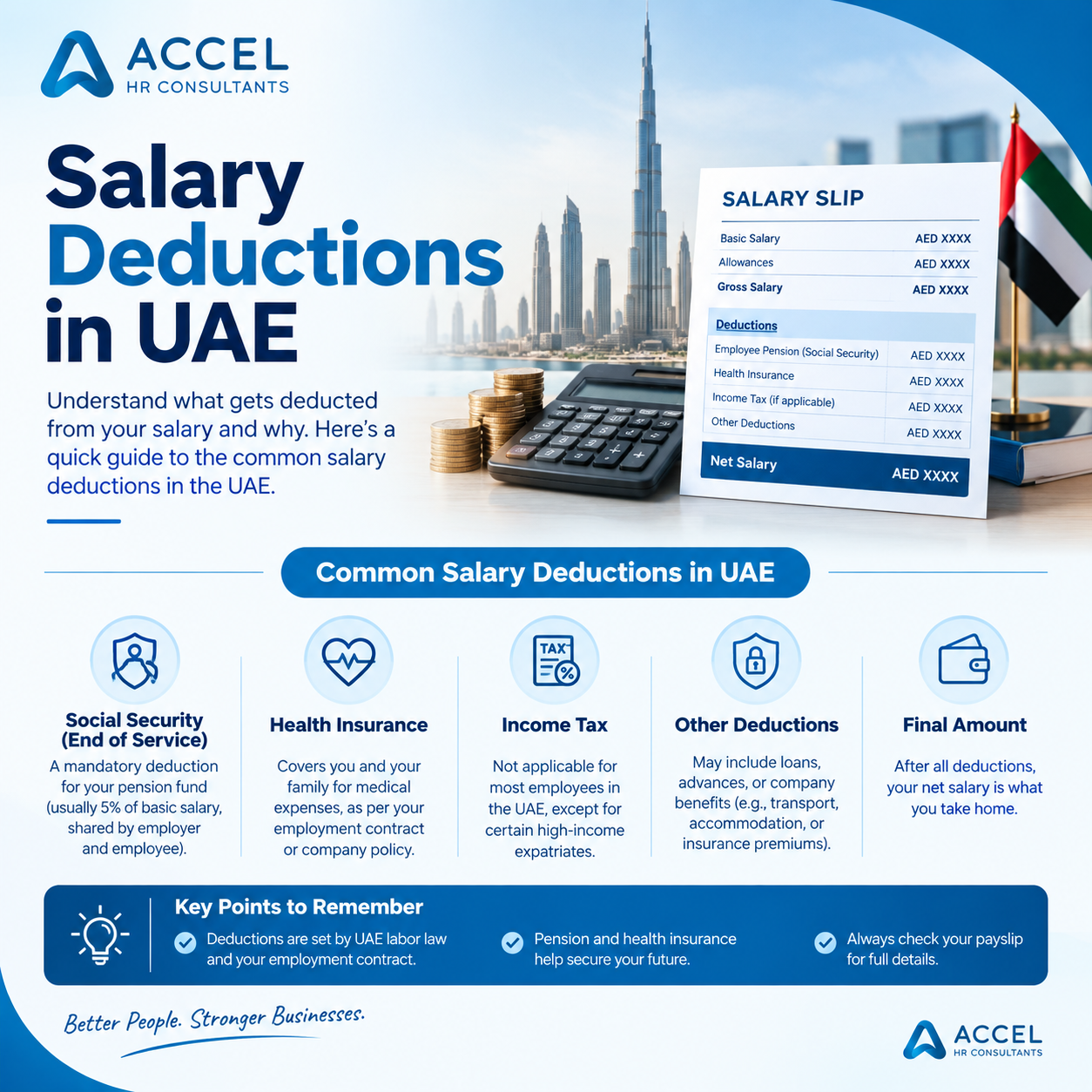
The Five Permitted Deduction Categories, With Exact Caps
Each category under Article 25 comes with its own specific limit, and employers are expected to apply each one individually rather than treating the 50% overall cap as a single bucket to fill however they like.
Recovery of overpaid wages. If a payroll error results in an employee being paid too much, the employer can recover the excess, but this specific deduction is capped at 20% of monthly wages.
Social contributions and savings funds. Contributions toward pension schemes, savings funds, insurance, or other MOHRE-approved benefit programs require the employee’s written consent and are capped at 20% of salary.
Loan or advance repayment. Recovering a loan or advance the employer granted requires the employee’s written consent, and critically, the employer cannot charge interest on top of the principal being recovered. No standard percentage cap applies here beyond the overall 50% ceiling, though repayment terms should be reasonable and documented.
Court-ordered debt. Where an employee owes a debt established by a court judgment, the employer may be required to deduct repayments, capped at 25% of wages. Alimony is a specific exception and can exceed this limit given its legal priority. If multiple court-ordered debts exist simultaneously, the employer distributes deductions based on priority.
Damage caused by the employee. If an employee’s negligence or a clear violation of instructions causes proven damage to company property, the employer can recover repair costs, capped at five days’ wages per month. Recovering more than this cap specifically requires court approval, it isn’t something an employer can decide unilaterally, even with documentation.
| Deduction Category | Cap | Consent Required |
|---|---|---|
| Overpaid wage recovery | 20% of salary | No, but must be documented |
| Social contributions/savings funds | 20% of salary | Yes, written |
| Loan/advance repayment | No interest allowed | Yes, written |
| Court-ordered debt | 25% of salary (alimony can exceed) | No, court-mandated |
| Employee-caused damage | 5 days’ wages/month | Requires court approval beyond cap |
Disciplinary Deductions and Suspension
Separate from the five core categories, employers can apply disciplinary deductions for documented workplace violations, but this comes with its own specific limit: capped at 5% of salary per violation, and only one penalty can be applied per individual violation.
If an employer suspends an employee during a disciplinary investigation, that suspension cannot exceed 30 days, during which the employer pays half the employee’s salary. If the investigation ultimately clears the employee, the withheld half must be paid back in full. Before any disciplinary penalty applies, the employer is required to follow a proper process, notifying the employee of the alleged violation and allowing them a genuine opportunity to respond, rather than deducting first and explaining later.
Deductions That Are Illegal, No Matter How They’re Labeled
A specific set of costs are explicitly barred from ever being deducted from an employee’s salary, regardless of internal justification.
Recruitment costs, visa and sponsorship fees, medical examination costs, and residency permit expenses cannot legally be passed on to the employee under any circumstances, this is the employer’s cost of doing business, tied directly to their visa sponsorship obligations. Bank charges or fees associated with transferring salary through WPS are similarly the employer’s responsibility, not the employee’s. Vague line items like “administrative fees,” “processing charges,” or “security deposits” that don’t map to one of the five Article 25 categories are prohibited outright, and except for court-ordered debts, every deduction requires the employee’s documented written consent.
The 50% Cap, and the 80% WPS Floor
Beyond the individual caps on each category, Article 25 sets an aggregate ceiling: total deductions in a single pay cycle cannot exceed 50% of the employee’s wage, no matter how many otherwise-legal deductions get combined. If an employee has a loan repayment and a court-ordered debt active simultaneously, the employer has to make sure the combined total still respects this ceiling.
There’s a related WPS-specific rule worth knowing: employers must ensure employees still receive at least 80% of their registered salary through the WPS system even after legal deductions are applied. This effectively works alongside the 50% cap as a second layer of protection, tracked directly through the payment system itself.
Is There a Minimum Wage in the UAE?
This question comes up constantly alongside deductions, since a low deducted wage means something very different depending on whether a wage floor exists. The honest answer is nuanced: there’s no universal statutory minimum wage for the general expatriate private-sector workforce under Article 26, which leaves the Cabinet room to set one but hasn’t established a blanket figure as of 2026.
That said, specific binding minimums do exist. Emirati employees in the private sector have a minimum of AED 6,000 per month, effective January 1, 2026. Domestic workers have a separate minimum of AED 1,750 per month under Ministerial Decree No. 52/2023, governed by their own distinct law rather than the general Labour Law. Beyond these two categories, immigration authorities apply qualification-based salary benchmarks when reviewing expatriate work permit applications, these aren’t minimum wages in the strict legal sense, but offering a salary well below the expected threshold for a given qualification level can result in the work permit itself being rejected.
What Happens When Salary Payment Itself Is Late
Deductions are one issue, but late payment is a related and equally regulated concern. If an employment contract doesn’t specify a payment schedule, wages default to being paid at least once a month. An employer is considered in default once payment is 15 days past the due date, and from there, MOHRE’s enforcement escalates on a defined timeline, generally starting with official reminders, moving to work permit suspension if the delay continues, and potentially reaching criminal prosecution referral for prolonged, uncorrected non-payment.
Disclaimer: This article summarizes the general deduction and payment framework under UAE federal labour law for informational purposes. Individual contracts, free zone regulations, or specific circumstances can affect how these rules apply, so it’s worth confirming your exact situation with an HR consultant or checking directly with MOHRE.
Salary Deduction vs. Salary Reduction
A deduction removes part of wages already owed under an existing contract for a specific, legally permitted reason. A reduction changes the base salary itself going forward, and that’s a fundamentally different legal action with its own approval path. MOHRE permits a temporary salary reduction by mutual agreement between employer and employee, but a permanent reduction requires additional MOHRE approval, documented through a supplementary agreement filed with the ministry. An employer cutting base pay and quietly processing it as a routine deduction, without following this separate approval path, is handling it incorrectly regardless of the business justification behind the cut.
How to Dispute an Illegal Deduction
If a deduction on your payslip looks wrong, start by comparing it against your WPS payment record and your original contract, since discrepancies are provable once wages flow through a traceable system. Raise it formally with HR in writing, referencing Article 25 directly, identifying which of the five categories the deduction claims to fall under, and explaining why it either doesn’t qualify or exceeds its specific cap. If it isn’t resolved internally, file a complaint through MOHRE’s official complaints portal or mobile app, which typically leads to mediation before any unresolved matter proceeds toward labour court.
FAQs
Q1: What is the maximum amount an employer can deduct from a UAE salary? Total deductions in a single pay cycle cannot exceed 50% of the employee’s wage under Article 25, regardless of how many individually valid deductions are combined. Individual categories also carry their own caps: 20% for overpayments and social contributions, 25% for court-ordered debts, and five days’ wages per month for damage.
Q2: Can my employer deduct visa or recruitment costs from my salary? No. Visa sponsorship fees, recruitment costs, medical examination costs, and residency permit expenses are explicitly prohibited from being deducted, regardless of how an employer labels or justifies them internally.
Q3: Is there a minimum wage in the UAE? There’s no universal statutory minimum for the general expatriate workforce. Emirati employees have a private-sector minimum of AED 6,000/month as of January 2026, domestic workers have a separate AED 1,750/month minimum, and expatriate work permits are reviewed against qualification-based salary benchmarks.
Q4: What’s the difference between a salary deduction and a salary reduction? A deduction removes part of wages already owed for a specific legal reason. A reduction changes the base salary itself, temporary reductions need mutual agreement, while permanent reductions require additional MOHRE approval through a filed supplementary agreement.
Q5: What should I do if I think a deduction from my salary is illegal? Compare your payslip against your WPS payment record and contract, raise the issue formally with HR citing Article 25 and the specific category it violates, and if unresolved, file a complaint directly with MOHRE.
A Final Thought
UAE salary deduction rules are more precise than most employees, and plenty of employers, realize: five defined categories, individual caps ranging from 5% to 25%, a 50% aggregate ceiling, and an explicit ban on shifting recruitment and visa costs onto employees. Knowing exactly where those numbers sit makes it far easier to spot when an “adjustment” on your payslip doesn’t hold up.
If you’re an employer trying to structure payroll deductions correctly, or an employee who wants a second opinion on a figure that doesn’t look right, Accel HR’s team can help you work through the specifics of your situation.