


A colleague resigns after four years, expects a solid payout, and receives a number thousands of dirhams below what she calculated at home. The reason almost always comes down to one detail: she used her total monthly salary instead of just her basic salary, and she’d also read somewhere that resigning cuts your gratuity, which hasn’t been true since 2022.
Gratuity math itself is simple arithmetic once you know the actual rules. The confusion comes from outdated information still circulating online, some of it on pages that claim to be “updated.” This guide walks through the real formula under current UAE law, with worked examples, and clears up the misconceptions that trip people up most.
What Is Gratuity, and Who Qualifies?
End-of-service gratuity is a legally mandated severance payment for private-sector employees in the UAE, governed by Article 51 of Federal Decree-Law No. 33 of 2021. Since the UAE doesn’t offer a state pension to expatriate workers, gratuity functions as the primary financial cushion when employment ends, whether through resignation, termination, or contract expiry.
To qualify, you need to have completed at least one continuous year of service with the same employer. This applies to full-time, part-time, and job-sharing arrangements alike, according to the official UAE Government portal. Anyone who leaves before hitting that one-year mark isn’t entitled to gratuity, regardless of how the employment ends.
UAE Gratuity Calculator
Estimate your end-of-service gratuity based on UAE Labour Law, Federal Decree-Law No. 33 of 2021, Article 51.
Basic salary only. Housing, transport, and other allowances are excluded.
E.g. for 4 years and 7 months of service, enter 4 and 7.
Need help with final settlements or payroll for your team?
Talk to an HR ConsultantThe Gratuity Formula, Step by Step
The calculation runs on a two-tier structure, and it’s worth memorizing both tiers since most employees end up somewhere between them.
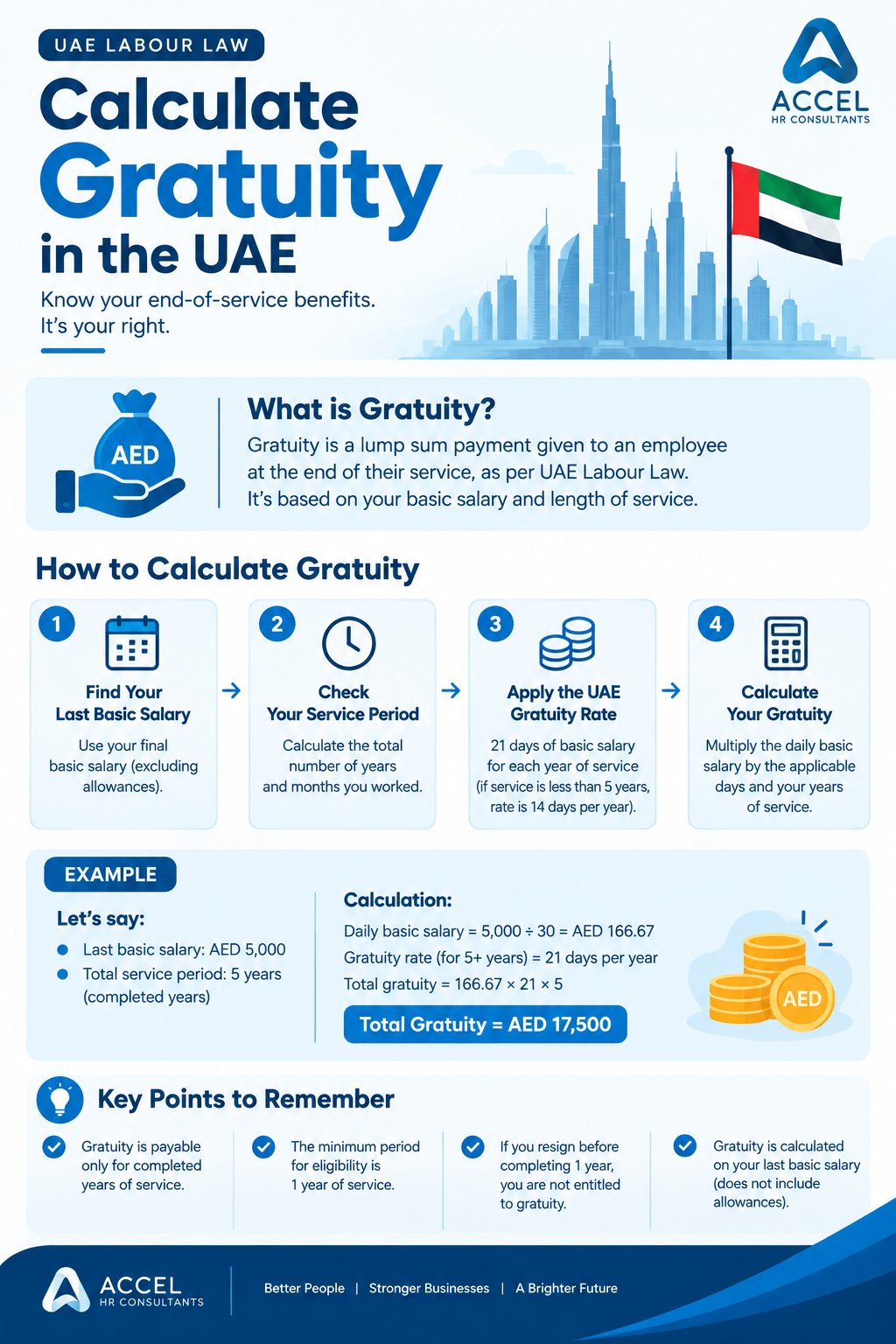
For the first five years of service, you earn 21 days of basic salary for every completed year. Once you cross the five-year mark, every additional year earns 30 days of basic salary instead. The formula anchors entirely to your basic salary, not your total monthly pay, housing allowance, transport allowance, commissions, and bonuses are all excluded from the calculation.
To find your daily wage, divide your basic monthly salary by 30. From there, multiply that daily figure by 21 (or 30, depending on the tier) for each qualifying year.
Quick Fact: If your contract lists AED 12,000 as total monthly salary but only AED 6,000 as basic salary, with the rest split into housing and transport allowances, your gratuity is built on the AED 6,000, not the AED 12,000. This single detail is the most common reason people overestimate their payout.
Worked Examples With Real Numbers
Numbers make this far easier to follow than formulas alone. Here’s how the calculation plays out at different service lengths, using a basic monthly salary of AED 9,000 (daily wage: AED 300).
| Years of Service | Calculation | Gratuity |
|---|---|---|
| 3 years | 300 × 21 × 3 | AED 18,900 |
| 5 years | 300 × 21 × 5 | AED 31,500 |
| 8 years | (300 × 21 × 5) + (300 × 30 × 3) | AED 58,500 |
| 12 years | (300 × 21 × 5) + (300 × 30 × 7) | AED 94,500 |
Notice how the payout accelerates after year five, since each additional year is worth 30 days instead of 21. Partial years also count, if an employee leaves after 8 years and 6 months, that extra half-year gets pro-rated into the final figure rather than rounded down.
Does Resigning Reduce Your Gratuity? (A Persistent Misconception)
This is worth addressing directly, because it’s genuinely wrong information that’s still floating around, sometimes on pages dated 2026. Under the old UAE Labour Law (Federal Law No. 8 of 1980), an employee who resigned before completing five years of service received a reduced gratuity, as low as a third of the full entitlement in some cases.
That reduction was abolished when Federal Decree-Law No. 33 of 2021 took effect on February 2, 2022. Under the current law, resignation and termination are treated identically for gratuity purposes. An employee who resigns after three years receives exactly the same gratuity as an employee terminated after three years, provided the one-year minimum service requirement is met.
If you come across a source claiming otherwise, especially one implying you’ll lose part of your gratuity simply for resigning, it’s describing a rule that hasn’t applied since early 2022.
The Two-Year Cap: When Does It Actually Matter?
Regardless of how long someone has worked for a company, total gratuity is capped at the equivalent of two years’ basic salary. For most employees, this cap is purely theoretical, it only becomes relevant at very long tenures combined with a high basic salary.
To put this in perspective, an employee earning AED 15,000 basic salary would need roughly 20+ years of service before the accumulated formula even approaches the two-year cap. For the vast majority of UAE employees, the standard 21/30-day formula produces the final number well before the cap becomes a factor.
When You’re Not Entitled to Gratuity
There are two scenarios where gratuity doesn’t apply. The first is straightforward: leaving before completing one full year of continuous service. The second is narrower, and it’s covered under Article 44 of the same law, which lists specific gross misconduct grounds, things like proven fraud, serious safety violations, or assault, that allow an employer to terminate without notice and without gratuity.
Outside these ten defined grounds under Article 44, gratuity cannot be withheld. If you’re unclear on how these narrow exceptions work, our detailed guide on employee termination in the UAE breaks down exactly what qualifies. It’s also worth noting that this same 2022 reform eliminated the old “limited vs. unlimited” contract distinction that used to affect gratuity outcomes differently depending on contract type.
Free Zones and Alternative Schemes
Not every part of the UAE follows the standard lump-sum gratuity model. The DIFC and ADGM operate their own separate employment frameworks, using a funded savings scheme called DEWS (DIFC Employee Workplace Savings) instead of the traditional end-of-service formula. Employers in these zones make regular contributions to an investment fund on the employee’s behalf, rather than calculating a lump sum at departure.
More recently, the UAE introduced a voluntary savings scheme that mainland employers can opt into as an alternative to traditional gratuity. Under this model, employers make monthly contributions to approved investment funds throughout the employment period, and the employee receives the accumulated amount plus investment returns upon leaving, rather than a lump-sum calculation at the end. This remains optional for most employers, so it’s worth checking with HR whether your company has opted into this model or still follows the standard Article 51 formula.
Payment Deadline and What to Do If It’s Late
Under Article 53, your employer is required to settle your full and final dues, including gratuity, within 14 days of your last working day. This isn’t a guideline, it’s a legal deadline. If your former employer misses this window without a valid reason, that’s a compliance issue you can raise directly with MOHRE.
Disclaimer: This article summarizes the general gratuity framework under UAE federal labour law for informational purposes. Individual contracts, free zone regulations, or employer-specific savings schemes can affect the final figure, so it’s worth confirming your exact entitlement with an HR consultant or checking directly with MOHRE for your specific situation.
FAQs
Q1: Is gratuity calculated on basic salary or total salary? Basic salary only. Housing allowance, transport allowance, commissions, and bonuses are excluded from the calculation, which is why the final figure is often lower than employees initially expect.
Q2: Does resigning reduce how much gratuity I get? No, not under current law. Since Federal Decree-Law No. 33 of 2021 took effect in February 2022, resignation and termination are treated identically for gratuity purposes, provided you’ve completed at least one year of continuous service.
Q3: What’s the maximum gratuity I can receive? Total gratuity is capped at two years’ basic salary, regardless of how long you’ve worked for the same employer. This cap only becomes relevant at very long tenures, typically 20 years or more, depending on salary level.
Q4: How long does my employer have to pay my gratuity? Under Article 53, gratuity and all other final dues must be paid within 14 days of your last working day. This deadline is legally binding, not a suggestion.
Q5: Do DIFC and ADGM employees get the same gratuity as mainland employees? No. These two free zones use a different system called DEWS, a funded savings scheme with regular employer contributions, rather than the standard 21/30-day lump-sum formula that applies to mainland and most other free zone employees.
A Final Thought
Gratuity calculation isn’t complicated once the formula is clear: basic salary only, 21 days per year for the first five years, 30 days per year after that, capped at two years’ pay. The real risk isn’t the math, it’s relying on outdated information about resignation penalties that stopped applying back in 2022.
If you’re an employer trying to calculate final settlements accurately, or an employee who wants a second opinion on a figure that doesn’t look right, Accel HR’s team can walk through the specifics of your situation. And if gratuity is just one part of a departing employee’s final dues, our guide to leave salary calculation in the UAE covers how unused leave gets folded into the same settlement.