


A recruiter asks for your experience letter, and you realize you’re not entirely sure what that’s supposed to look like, or whether the “employment certificate” your last company gave you actually counts. Four different documents get thrown around interchangeably in the UAE, experience letter, service certificate, employment certificate, salary certificate, and mixing them up can genuinely delay a job offer, a visa application, or a bank loan.
This guide covers exactly what an experience letter needs to contain, the format employers actually use, how MOHRE fits into the picture, and what to do if your employer won’t give you one.
What Is an Experience Letter?
An experience letter, also called an experience certificate or service certificate, is a formal document your employer issues confirming your employment history with the company: your job title, the dates you worked there, and a general statement about your service. It’s typically requested when you leave a job, and it’s one of the most commonly asked-for documents when applying to a new employer in the UAE.
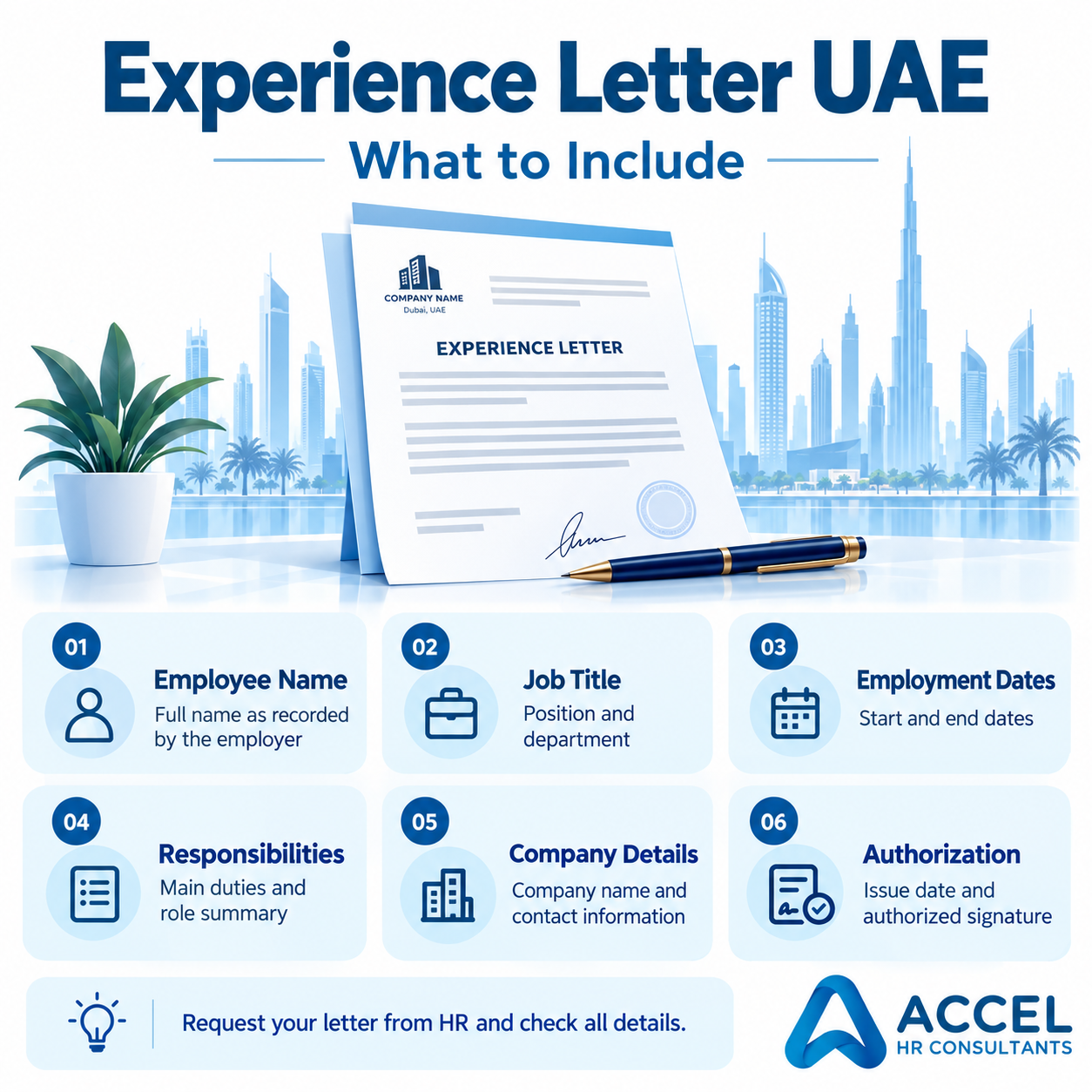
Under Article 15 of Federal Decree-Law No. 33 of 2021, employees have the legal right to request this certificate from their employer at the end of the employment relationship, and it needs to include your role, your joining and end dates, and your final salary if requested. One detail the law is specific about: the certificate cannot include any statement that could damage your reputation or hurt your chances with a future employer. If a company writes something negative into your experience letter, that’s not just unprofessional, it’s a legal problem.
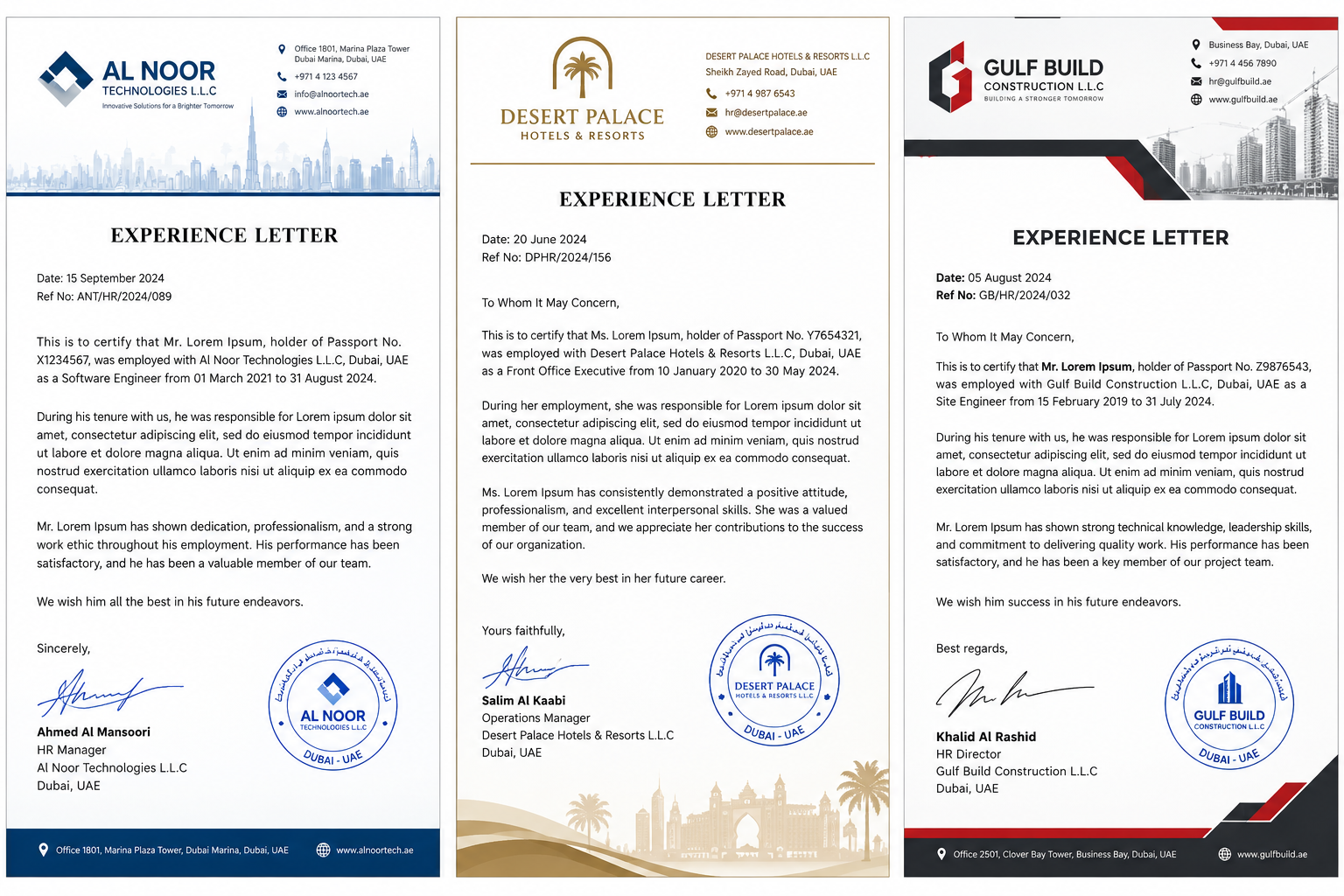
Experience Letter Sample
Experience Letter vs. Employment Certificate vs. Salary Certificate: They’re Not the Same Thing
This is where most confusion comes from, and it’s worth being precise about it since each document serves a different purpose.
| Document | When It’s Issued | Main Purpose |
|---|---|---|
| Experience/Service Certificate | At the end of employment | Proves your work history to a new employer |
| Employment Certificate | While you’re still employed | Confirms current employment for visas, tenancy, or loans |
| Salary Certificate | While you’re still employed | Confirms your pay, mainly for banks and credit applications |
| NOC (No Objection Certificate) | On request, from a current employer | Permission for a second job or business setup |
An experience certificate looks backward, it’s proof of what you did and how long you did it. An employment certificate looks at the present, confirming you’re currently employed somewhere, which is what ICP and GDRFA typically ask for during visa or residency processes. A salary certificate exists purely to confirm your pay for a bank or credit card application. If you’re applying for a new job, you need the experience certificate. If you’re applying for a mortgage while still employed, you need the salary certificate. Handing over the wrong one is a common, and avoidable, mistake.
What Should an Experience Letter Actually Include?
A properly formatted UAE experience letter is issued on official company letterhead and generally includes the following details: your full legal name, your job title, your joining date and last working day, a brief description of your role or department, and a closing line confirming the company has no objection to your future employment elsewhere. Many employers also include the reason for leaving, resignation, contract expiry, or termination, though this isn’t strictly mandatory.
Quick Fact: A printed experience letter without a wet signature and the company’s official stamp is often treated as invalid for government use in the UAE, embassies, MOFA, and immigration authorities generally won’t accept a document that’s missing either.
A Basic Experience Letter Format
Most UAE experience letters follow a fairly standard structure. It opens with the company letterhead, including the trade licence number, followed by the date and a “To Whom It May Concern” heading. The body confirms the employee’s name, position, and employment dates, briefly describes their responsibilities, and states there were no issues during their tenure. It closes with the signatory’s name, designation, and the company stamp.
If you’re an employer putting one together, keeping this structure consistent across the company protects you from disputes later, since a vague or inconsistent letter is far more likely to raise questions with a new employer or immigration authority than a clear, standardized one.
Can You Get an Experience Letter Through MOHRE?
Yes, and this is worth knowing if your previous employer is dragging their feet. MOHRE’s mobile app allows UAE private-sector employees to generate an official Employment History Certificate directly, which serves as supplementary proof of your work history alongside, or in place of, a company-issued letter. It won’t include the same personal detail a company letter might, like a description of your specific responsibilities, but it does confirm your job title, employer, and employment dates through an official government record.
This MOHRE-generated document carries real weight specifically because it comes from the government’s own labour records rather than the company itself, which makes it harder to dispute.
Experience Certificate Attestation for UAE
If you’re taking your experience letter abroad, applying to another country, submitting it to a foreign embassy, or using it for professional licensing outside the UAE, you’ll likely need it attested. Attestation is the process of getting a document officially verified through a chain of authorities: typically starting with the UAE Ministry of Foreign Affairs (MOFA), and depending on the destination country, potentially the relevant embassy as well.
Attestation confirms the document is genuine and was issued by a legitimate, licensed UAE company, it’s a separate step from simply having a signed and stamped letter. If your new employer or a foreign authority specifically asks for an “attested” experience certificate, a plain signed copy won’t be enough, you’ll need to go through this formal verification process before it’s accepted.
What If Your Employer Refuses to Give You One?
Under UAE Labour Law, refusing to issue an experience certificate on request is a violation, and employees have a straightforward path to resolve it. You can file a complaint directly with MOHRE through their website, app, or call centre. MOHRE typically contacts the employer to resolve the issue quickly, often within days, since this is treated as a routine compliance matter rather than a complex dispute. There’s no cost to the employee for filing this kind of complaint, and any costs associated with resolving it fall on the employer if they’re found non-compliant.
Disclaimer: This article summarizes the general framework under UAE federal labour law for informational purposes. Specific requirements can vary slightly by free zone or emirate, so it’s worth confirming your exact situation with MOHRE or an HR consultant.
Why This Document Matters More Than People Expect
An experience letter isn’t just a formality you file away. New employers commonly verify employment history before finalizing an offer, and gaps or inconsistencies between your CV and your experience letters can raise questions during background checks. It also plays a role in visa sponsorship for your next role, since some employers and immigration processes ask for proof of your prior employment history as part of due diligence.
If you’re actively job hunting and want your documentation to hold up under scrutiny, it’s worth requesting your experience letter the moment you resign, rather than weeks later once HR contacts have moved on and the process takes longer to chase down.
FAQs
Q1: Is an experience letter mandatory in the UAE? Yes. Under Article 15 of Federal Decree-Law No. 33 of 2021, employees have the right to request one from their employer, and the employer is required to provide it without including any statement that could harm the employee’s future job prospects.
Q2: What’s the difference between an experience certificate and an employment certificate? An experience certificate is issued when you leave a job and confirms your work history. An employment certificate is issued while you’re still employed and simply confirms you currently work there, commonly used for visas or tenancy applications.
Q3: Can I get my experience letter directly from MOHRE instead of my employer? Yes, MOHRE’s app allows private-sector employees to generate an official Employment History Certificate as supplementary proof, though it won’t include role-specific details a company letter might provide.
Q4: Do I need to get my experience letter attested? Only if you’re using it outside the UAE, for a foreign embassy, international job application, or professional licensing abroad. Attestation typically goes through the UAE Ministry of Foreign Affairs and, depending on the destination, the relevant embassy.
Q5: What can I do if my employer refuses to issue my experience letter? File a complaint with MOHRE directly through their website, app, or call centre. This is treated as a standard compliance issue and is typically resolved within a few working days at no cost to you.
A Final Thought
An experience letter is a small document that carries a lot of weight, it’s often the first thing a new employer checks against your CV, and the wrong version of it can hold up a visa, a loan, or a job offer you’re otherwise ready to accept. Knowing exactly which document you need, and that you’re legally entitled to get it, makes the whole process far less stressful when you’re already juggling a job change.
If you’re an employer looking to standardize how your company issues these documents, or an employee who’s run into resistance getting yours, Accel HR’s team can help you sort it out properly.