


A new mother in Dubai’s private sector gets 60 days off. Her sister working for Abu Dhabi’s government gets 90. A colleague’s husband, also in Abu Dhabi’s government, just found out his paternity leave doubled overnight. None of this is a mistake, it’s just how fragmented UAE maternity and paternity leave rules actually are, split across federal law, individual emirate decrees, and free zone frameworks that all move independently of each other.
This guide breaks down exactly what you’re entitled to depending on where you work, what’s paid and what isn’t, and a few genuinely new changes from 2026 that most people haven’t caught up on yet.
Maternity Leave in the Private Sector
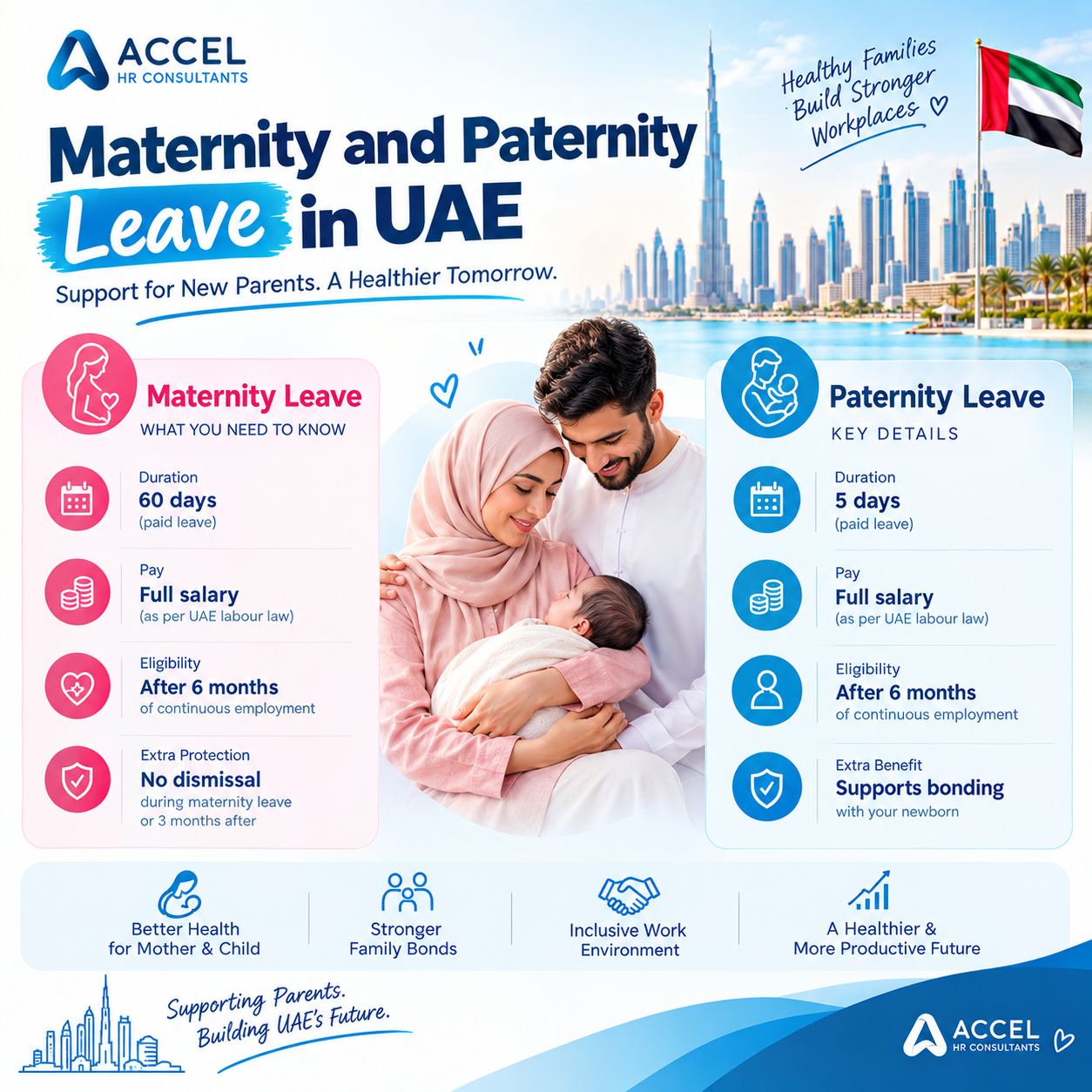
Under Article 30 of Federal Decree-Law No. 33 of 2021, female employees in the UAE private sector are entitled to 60 calendar days of maternity leave. The first 45 days are paid in full, and the remaining 15 days at half pay.
There’s no minimum service requirement to qualify, this is a meaningful change from the older law, and it means you’re entitled to maternity leave from your very first day of employment, regardless of how recently you joined the company.
Extended Leave for Medical Complications
If a newborn is born with a medical condition or disability requiring ongoing care, the mother is entitled to an additional 30 days at full pay, starting once the standard maternity leave period ends. Beyond that, a further 30 days unpaid can be taken if a medical report supports the need for continued care.
Nursing Breaks After Returning to Work
Once you’re back at work, the law provides for one or two nursing breaks a day, totaling between one and two hours combined, for the first six months after your return. This time is protected and doesn’t count against your regular working hours.
Job Protection
It’s illegal for an employer to terminate an employee, or serve notice of termination, because of pregnancy or maternity leave. If this happens, it falls under the UAE’s arbitrary dismissal provisions, and the employee has grounds to file a formal complaint with MOHRE.
Paternity Leave (Parental Leave) in the Private Sector
The UAE Labour Law technically calls this “parental leave” rather than paternity leave, but in practice, it functions as the UAE’s paternity leave entitlement for fathers. Under Article 32 of Federal Decree-Law No. 33 of 2021, private-sector employees, both mothers and fathers, are entitled to 5 working days of fully paid leave within six months of the child’s birth.
Note that this is working days, not calendar days, and it can be taken continuously or split across separate days within that six-month window. For mothers, this parental leave entitlement sits entirely separate from, and in addition to, the standard 60-day maternity leave.
Government Sector Maternity and Paternity Leave
This is where things genuinely diverge, and where a lot of outdated information still circulates online, since each emirate’s government sector runs on its own local decree. The official UAE Government portal breaks down each of these separately.
Federal government employees, under Federal Decree-Law No. 49 of 2022, receive 90 days of fully paid maternity leave for a female employee in a permanent position. Male federal government employees are entitled to 3 working days of paternity leave under separate federal human resources law, less generous than the 5-day private-sector entitlement.
Dubai Government follows its own framework under Decree No. 14 of 2017, granting 90 days of maternity leave starting from the delivery date. Annual and unpaid leave can be added on top, extending the total time off to as much as 120 days.
Sharjah Government has provided 120 days total since a 2016 local decree, split as 90 days paid followed by 30 days unpaid.
| Sector | Maternity Leave | Paternity/Parental Leave |
|---|---|---|
| Private sector (federal law) | 60 days (45 full pay + 15 half pay) | 5 working days |
| Federal government | 90 days, full pay | 3 working days |
| Dubai Government | 90 days (up to 120 with added leave) | Varies by entity |
| Sharjah Government | 120 days (90 paid + 30 unpaid) | Varies by entity |
| Abu Dhabi Government | 90 days, full pay | 6 days (up to 16 for multiple births), from Jan 2026 |
What’s New in 2026: Abu Dhabi Doubles Paternity Leave
This is genuinely recent, and worth knowing if you or someone on your team works for an Abu Dhabi government entity. Under Human Resources Law No. 8 of 2025, effective January 1, 2026, Abu Dhabi doubled paternity leave for government employees from 3 days to 6 days, extending to 16 days for multiple births (twins, triplets, and so on), as reported by Khaleej Times. The change applies across more than 25,000 employees in Abu Dhabi’s government entities, making it one of the most generous paternity provisions in the country’s public sector.
The update sits within the UAE’s broader “Year of Family 2026” initiative, alongside other family-focused policy moves happening across the country this year.
A Proposal Still Under Discussion
Separately, in January 2026, the UAE’s Federal National Council recommended extending fully paid maternity leave in the federal government sector to a minimum of 98 days, aligning more closely with international labour standards. As of the most recent updates, this remains a recommendation rather than enacted law. Historically, changes like this in the government sector have eventually influenced private-sector amendments too, so it’s worth watching, though nothing has changed for private-sector entitlements yet.
Disclaimer: Government sector leave entitlements are set through emirate-specific decrees and can change through new resolutions with limited notice. The figures above reflect the framework as of 2026, so if you work in the government sector, it’s worth confirming your exact entitlement directly with your entity’s HR department or MOHRE.
DIFC and ADGM Have Their Own Rules
Free zones with independent employment frameworks don’t automatically follow the federal Labour Law described above. DIFC provides 65 working days of maternity leave at full pay under its own Employment Law, more generous than the mainland’s 60-day entitlement. ADGM operates under a similarly separate framework. If you’re employed within either zone, check the zone-specific law directly rather than assuming the standard federal figures apply.
Can You Resign or Be Terminated During Maternity Leave?
You’re legally protected from termination specifically because of pregnancy or maternity leave, but you can still choose to resign during this period if you decide to. If you’re navigating this alongside broader questions about ending your employment, our guide on notice periods in the UAE covers how resignation timelines work more generally.
FAQs
Q1: How many days of maternity leave do private sector employees get in the UAE? 60 calendar days total under Article 30 of Federal Decree-Law No. 33 of 2021, the first 45 days at full pay and the remaining 15 days at half pay. There’s no minimum service requirement.
Q2: How many days maternity leave in UAE for government sector employees? It depends on the emirate. Federal government employees receive 90 days, Dubai Government offers 90 days (extendable to 120 with added leave), and Sharjah Government provides 120 days total (90 paid, 30 unpaid).
Q3: How many days is paternity leave in the UAE? Private-sector fathers get 5 working days under Article 32, technically called parental leave, within six months of the child’s birth. Government sector fathers vary by emirate, federal government employees get 3 days, while Abu Dhabi government employees now get 6 days (up to 16 for multiple births) as of January 2026.
Q4: Is maternity leave paid in full in the UAE? In the private sector, only the first 45 days are paid in full, the remaining 15 days are paid at half rate. Government sector maternity leave is typically paid in full for the standard entitlement period.
Q5: Can my employer fire me while I’m on maternity leave? No. Terminating an employee, or issuing termination notice, because of pregnancy or maternity leave is illegal under UAE Labour Law and can be challenged as arbitrary dismissal.
A Final Thought
UAE maternity and paternity leave rules genuinely depend on where you work, private sector, federal government, or a specific emirate’s government entity all follow different numbers, and 2026 has already brought real changes for some of these groups. Knowing exactly which framework applies to you means you’re planning around the right numbers, not the ones a colleague in a different sector happens to have.
If you’re an employer trying to keep your leave policies accurate and compliant, or an employee unsure exactly what you’re entitled to, Accel HR’s team can help you work through the specifics of your situation.